Both Samuel N. Dorf and Christopher Moore have credibility as published musicologists who specialize in studies surrounding music in Paris and LGBTQ+ history. Their arguments and queer readings of composers allow us as students and researchers to enhance our critical thinking skills; we can appreciate the scholarship and dedication the authors have contributed to their writing, but we can also delve past the words on the page to analyze if their claims are justified or too dissentient.
Beginning with Dorf’s work titled “Étrange n’est-ce pas?”: The Princesse Edmond de Polignac, Erik Satie’s Socrate, and a Lesbian
Aesthetic of Music?” , Dorf lacks a concrete thesis statement that drives the entire article forward. This is a rather non-traditional approach to presenting research, especially when making distinct claims about gender and sexuality. However, Dorf opts to present detailed historical context and direct quotes from Satie and the Princess de Polignac herself. The inclusion of these excerpts strengthens Dorf’s writing because we are able to rely on another outside primary source rather than simply his own claims. For example, Satie introduced brand new vocabulary when describing Socrate such as “white, pure, antique, gentle, free, clear, classical, simple, modern, cubist, precise, and new”, which helps Dorf prove that Socrate was a product of the transforming modernist view of music .1 He also cleverly quotes the Princess to articulate further how Socrate was meant to be something new, modern, and perhaps neoclassical even though it was based on “simple and poetical” Greek dances. 2 This type of writing is his clearest and most convincing.
When it comes to the relation of Satie, Socrates, and the Princess to queer themes, I find that Dorf’s writing at times becomes exaggerated. When beginning to write of the relationships of women, whether romantic, platonic, or sexual, he begins to use different language such as “deliciously”, “tantalizing”, and “flamboyant”. It is within sections such as these that he starts to lose my favor a bit as a reader. It is especially common to sexualize relationships between women and women themselves, so in the middle section of the reading– where Dorf is explaining the Princess’ interactions with women such as Ethel Smyth and Anna de Noailles– I find myself less convinced that he is necessarily arguing for anything or if he is instead trying to maintain a reader’s interest by showing the “exoticism” of lesbian relationships in the early 20th century. However, toward the end of his writing, he turns it back around to more historical and educational writing explaining how the Princess de Polignac had to work hard to maintain her “aristocratic respectability” in order to keep her salon safe and successful for composers, performers, and others of LGBT status.3
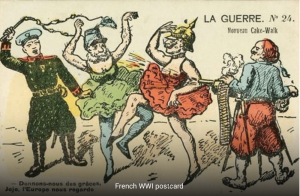
Before moving onto Moore’s entry in The Musical Quarterly, here is an interesting source to learn more about homophobia in the early 20th century and how it related to WW1.
Moore mirrors Dorf in the sense that he also uses specific historical evidence to support his writing. He highlights Poulenc’s own concerns abut the “abnormality” of his sexuality, especially his love for Richard Chanlaire.4 This gives us important context to how Poulenc felt about his own identity and how it may have crept into his music intentionally or unintentionally. His study of specific pieces such as Les Biches and the study on “camp” allow us to understand the lens from which he is viewing the composer and his works. Les Biches includes sexual deviations from the heteronormative atmosphere in which they were presented. For example, Moore explains several techniques of same-sex attraction, dross dressing, and androgyny that allowed Poulenc to explore and express trends that played upon the traditional norms of the day.
I am particularly fascinated by how Moore interprets specific musical moments in Les Biches. When he explains in more detail the woman in Blue Drag’s choreography and distinct stylistic choices, he pairs it with examples from the music, an example of which you can find below:
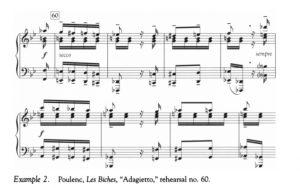
While it is effective to explain how Poulenc’s specific musical rhetoric accompanies his characters and their movements, Moore’s argument becomes more well-rounded when he combines musical jargon with details of costuming and choreography that the less musically inclined reader can understand.
Moore’s article seems to be many theses all combined into one. I would argue that this particular work aims to cover a lot of content in perhaps not quite enough room. He makes good and interesting claims about both Les Biches and Aubade, but I found that the most concrete claims weren’t clear to me until the end of the work: “Les Biches confirms that Poulenc was naturally inclined to expressions of the sexually liminal, Aubade reveals the extent to which the “double extent” of camp allowed for a particularly moving examination of the composer’s own sexual insecurities and anxieties”5. Perhaps it is because I am not a professional researcher, but I would have found it helpful to have these claims hinted at at the beginning so I could have more of a context for my own understanding of the text.
Overall I found both arguments to be extremely intriguing, but Moore’s failed to mention the aspects of Poulenc’s life that gave him privilege, such as being a man and being French and white! (French people loved French people right? I think they did. Correct me if I’m wrong). I often find that when discussing sexuality, it becomes almost to hyper-focused on that one aspect. While, of course, sexuality is a huge part of identity, I think it’s important to mention other sociological factors that influenced these composers’ and patrons’ lives.
Footnotes:
1 Dorf, Samuel N. “Étrange n’est-ce pas?”: The Princesse Edmond de Polignac, Erik Satie’s Socrate, and a Lesbian
Aesthetic of Music?” FLS, Volume XXXIV (2007): 89
2 Ibid., 90
3 Ibid., 96
4 Moore, Christopher. “Camp in Francis Poulenc’s Early Ballets.” The Musical Quarterly 95, no. 2/3 (2012): 299-342. Accessed April 23, 2020. 300-301. www.jstor.org/stable/41811629
5 Ibid., 331-332