Negrophilia in Paris in the 1920’s did not reflect a deep admiration that the French public had for Africans and African-Americans, but rather reflected the long running practice of exoticisim and appropiation, long established in France. Specifically, writer’s use of Jazz at the time was highly problematic. When primitivism was a style popular in the works of Stravinsky, Auric, and others, Jazz offered a deep well of inspiration to draw from.
Jordan 1 talks about the frenetic expression that jazz presented and how many composers and writers of jazz in France latched on to American jazz writers’ use of rhythm. This type of musical element borrowing reminds me strongly of how Debussy “borrowed” the whole tone scale and counterpoint writing of a Javenese Gamelan orchestra. Jordan discusses how several writers of the day described the “natural rhythm” of blacks and how it presented itself in their dance and their music.
The dichotomy that France struggled the most with, was the portrayed primitivism of Jazz, endowed with a sense of american modernism. Jordan states “Once more, the revue’s modern sensibility clashed with fixed ideas about primitive negre, creating dissonance and tension” (108). Although the music may have been respect and adored for it’s cutting edge modernity, it was still used to supplement “exotic” characters of primitivism.
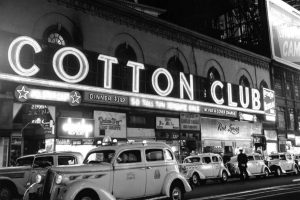 This practice reminds me of America’s own Cotton Club in New York. The Cotton Club featured artists like Duke Ellington and Cab Calloway but would only admit white audiences to watch. Often, jazz would be played as “jungle music” to accompany shows with dancers in “jungle garb.”