Negrophilia, which literally means “love of blacks”, was a major artistic and cultural movement in 1920s Paris. White Parisians became very fascinated with black culture, both native African and black American.1 The primary reason that this movement arose was the large influx of black soldiers into France during World War I. In the late 1800s, the European countries had divided the continent of Africa between themselves, since the native people who lived there were far less technologically advanced than Europeans, making them unable to put up effective resistance.2
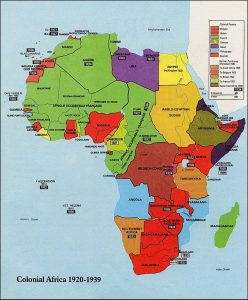
By 1920, the only African country to be under native rule was Abyssinia (modern Ethiopia), although it, too, was eventually colonized by Italy in 1936. Liberia was independent, but it was ruled by the descendants of African-Americans, not by the native Liberians.3 South Africa was a self-governing British Dominion, but political power was held almost exclusively by its White minority, which made up slightly less than 1/4 of the country at the time. Southern Rhodesia would follow in South Africa’s footsteps and become a self-governing colony in 1923, having rejected uniting with South Africa. (Southern Rhodesia would later unilaterally declare independence from the United Kingdom as the Republic of Rhodesia under the rule of World War II veteran Ian Douglas Smith).4

When World War I broke out, France needed more troops than they could get from France proper, so they turned to their African colonies for manpower. One of their African colonies, Algeria, had many French settlers in it, and was considered an integral part of France itself, just like Alaska and Hawaii are to America. In the early 20th century, 15% of the Algerian population was European. It’s important to note, however, that many of the Europeans in French Algeria were Italians, Maltese, Spaniards, or local Algerian Jews who were granted French citizenship by the Cremieux Decree of 1870.5 They had rights that the natives of the French colonies didn’t, such as the right to elect representatives and move to France. This meant that most French people had never seen an African before African soldiers showed up to fight in World War I. As is common when different cultures encounter each other, the French were fascinated by the Africans and their cultures, but also misunderstood them in many ways, and saw them as primitive savages who were beneath the French culturally.
Francis Poulenc’s Rapsodie Negre is a perfect example of this. Allegedly a setting of poems by Makoko Kangourou, a Liberian poet who never really existed,6 it is a bunch of faux-African sounding syllables strung together, for example:
Honoloulou, pota lama!
Honoloulou, Honoloulou,
Kati moko, mosi bolou
Ratakou sira, polama!
This shows that Negrophilia was a love for a warped version of African culture, and not a genuine love for Africa.
SOURCES
1 Boittin, Jennifer Anne. Colonial Metropolis: the Urban Grounds of Anti-Imperialism and Feminism in Interwar Paris. Lincoln: University of Nebraska Press, 2015.
2 Chamberlain, Muriel Evelyn. The Scramble for Africa. London: Longman, 1999.