Phila, the root of Negrophilia, comes from one of four the Greek words for love. Philia is often translated as “brotherly love” or friendship; it is the love of equals. Unfortunately, the term Negrophilia as it was employed by Parisians in the 1920’s, does not live up to its namesake. While Parisians certainly held a peculiar fascination with Negro music and dance, this obsession doesn’t seem to be consistent with the true meaning of philia as a love of equals.
When Parisian musicians, artists or critics encounter African American culture it is often described by seemingly contradictory ideas or overwhelming emotions. When Pablo Picasso stumbled upon the African section of the Trocadero, “his first impression was one of disgust” [1]. However, as Picasso processed the “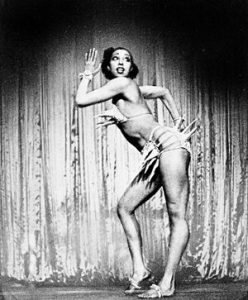 shock” and “revelation” upon encountering these artifacts his disgust turned to fear and then fascination. He felt a “ ‘force’ emanating from this ‘frightful museum’ ” and soon regarded the masks as “magical things” [1]. This visceral reaction to African-ness is also mirrored in the reception La Revue Négre. The show was incredibly popular, and the French public became enamored with the show’s star Josephine Baker. People poured in to “take a peek at La Baker and see what the fuss was about” [2]. Reactions varied from screams of delight to screams of disdain, but the common denominator was a wholly provocative response [2].
These strong reactions all serve to illustrate the Parisian fixation on African and African American culture. For some, such as Milhaud or Cocteau, perhaps this fixation verges on admiration, more closely resembling love. Cocteau abstains from the usual descriptions of African American dance as “primitive”, “child-like”, or “naturally frenzied”. Instead he emphasizes its “sharp angularities”, “broken rhythms” and “modernity”[1]. Another Parisian, Paul Guillaume, expresses this admiration rather explicitly proclaiming that “negro art is the fructifying seed of the spiritual twentieth century”[1].
However, by and large this Parisian fixation with African-ness was not really admiration and certainly didn’t view this other as an equal. From Levinson’s review of the Negro dance it is clear that while Levinson was fascinated with its primitive and rhythmic elements, he did not necessarily consider it as an art form like the classical ballet. Levinson believed that Negro dance relied upon a “formless and purely instinctual motor energy” that originated in the uncivilized savage [3]. Although his romantic primitivism grants some credence to Josephine Baker’s “magnificent gyrations”, he remains ultimately dismissive of the Negro dance as a serious art form.
This inevitable dismissal is also echoed in the critic’s reviews of La Revue Négre. Jordan describes a common thread of ambivalence among reviewers, explaining that there was a discursive movement to distance French-ness from African-ness. For example, Jean-José Frappa worried that “the foreign invasion and influence … was corrupting the purity of French culture” [2]. Ultimately the French were not interested in an honest investigation of African or Afro American culture. They could not truly love African Americans as an equal; they were only interested in their culture to the extent that it benefited their own.
[1] Bernard Gendron, Between Montmarte and the Mudd Club (Chicago: The University of Chicago Press 2002), 103-116.
[2] Matthew Jordan, Le Jazz: Jazz and French Cultural Identity (Urbana-Champagne: University of Illinois Press, 2010), 102-111.
[3] André Levinson, “The Negro Dance: Under European Eyes,” in André Levinson on Dance: Writings from Paris in the Twenties, ed. Joan Acocella and Lynn Garafola (Hanover: Wesleyan University Press, 1991), 69-75.