Negrophilia, as defined by Bernard Gendron, was an infatuation with American and “primitive,” or African culture (1). By using the word primitivism to describe music with African influence, one is already assuming a distinction between a developed versus undeveloped group of people. “Primitivism” makes reference to primates, dehumanizing African culture and implying it is less civilized than European cultures that are not “primitive.”
Milhaud’s fascination with Harlem created a new kind of experience for a French composer, as exposure to Jazz clubs and street music were rare. Milhaud in a way was more inspired by Gershwin, an American inspired by the African American rooted music, making it a blurred line between inspiration from America and inspiration from Africa. Upon Milhaud’s first journey to New York, he described a black female jazz singer’s voice as deep and dramatic (2).
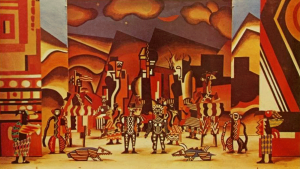
In Andre Levinsons’ The Negro Dance, he acknowledged the most defining aspect of African inspired music was ryhthm. The metric, percussive sounds of so-called “negro dancing” in contrast to European dancing is what made it so intriguing to French people (3). Josephine Baker, a young African American dancer, became the symbol of “negro dance” in France, an exotic woman different from women of La Ballet Russe and other European dance styles.
As Levinson points out, all types of folk dance and music, including in western europe, are centered around rhythm and meter, which is ultimately what drove the popularity of African influenced music. He refers to the folk dancer as a “savage dancer,” an idea that had already been drawn upon by Ravel and Debussy when they created Spanish inspired classical music, and when Stravinsky drew upon influences of Russian folk music. All of these efforts to incorporate other cultures really created an othering effect.
In the debate of whether or not African culture was admired or fetishized, it ultimately comes down to this question:
Would Josephine Baker have been as popular if she were white? If she were French or European?
Clearly, part of Josephine Baker’s fame came from the prospect of her being black, and being seen as an exotic woman made her more famous, even if it was for the wrong reasons.
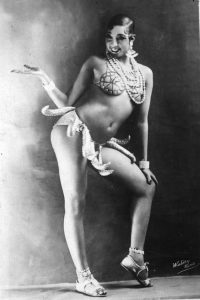
Even in the case of Josephine Baker, she did not sing music that represented her culture, but rather an exoticized, white man’s interpretation of what “black music” meant. This is the same pattern we have seen in most of the “new” French music, with Brazil, Spain, Russia, and American Jazz (4). The music is a caricature or a version adapted by the French to fit their tastes, instead of actually representing the music. This just furthers the eurocentrism in classical music instead of making awareness for other culture’s music.
(1). Gendron, Bernard. Between Montmartre and the Mudd Club: Popular Music and the Avant-Garde. Chicago: Univ. of Chicago Press, 2002.
(2). Platt, Russel.l “The Music of Darius Milhaud” The New Yorker. 23 Jun. 2017, https://www.newyorker.com/culture/culture-desk/the-indomitable-humanism-of-darius-milhaud. Accessed 8 Mar. 2020.
(3). Levinson, André, Joan Ross. Acocella, and Lynn Garafola. André Levinson on Dance: Writings from Paris in the Twenties. Hanover, NH: Wesleyan University Press, 1991.
(4). Murari , Tim. “The Enigmatic Josephine Baker – Interview: Archive, 26 August 1974.” The Guardian. Guardian News and Media, August 26, 2015. https://www.theguardian.com/stage/2015/aug/26/josephine-baker-interview-1974.