As far as francité in music goes, it is both emotionally and economically driven, as well as highly subjective what gets included and excluded. My essay is about Arthur Honegger, a financially successful composer, at least by many accounts. One of my main sources is a book by Harry Halbreich creatively titled Arthur Honegger. Halbreich, a Belgian musicologist[1], studied with Honegger in Paris and can therefore lend some legitimacy to the selection made in the book as well as the context he provides in order to create a flowing narrative.
The book contains contextualized excerpts from Honegger’s own writings, as well as some of his wife’s, so it culminates as both primary and secondary material. My essay takes the form of a diary entry of Honegger’s wife pianist, composer and teacher Andree Vaurabourg, looking back at the past decades in 1929. Halbreich refrains from sensationalising Honegger’s liaison with singer Claire Croiza, yet acknowledges it and tries to provide some nuance to what can only be described as a complex marital arrangement. Long story short, Honegger met Croiza when she was hired to perform his music, they got pregnant and had a son that he claimed as his own. Three weeks later he married Vaurabourg on the condition that they lived separately because he needed complete solitude to nurture his genius and compose.
This is more than Pascal Lécroart mentions in his text for the Arthur Honegger Association’s[2] website, as he does not mention Croiza nor their child, and disregarding what was both an economic and emotional influence on Honegger. Halbreich’s personal relationship with Honegger is a source of both credibility and biases as he would have heard Honegger’s own version of events to some extent, and supported said version with Honegger’s own writings.
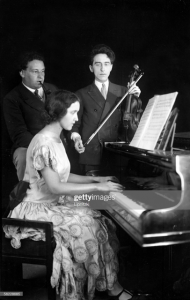
Paris, around 1925. Arthur Honegger with pipe, Jean Cocteau with violin and Andree Vaurabourg (at the piano)
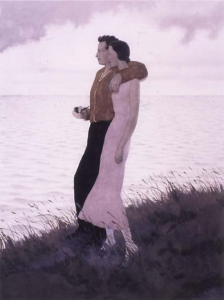
Lithography of Andree Vaurabourg and Arthur Honegger by A.E. Marty in 1932
In my fictional diary entry by Vaurabourg, she reminisces back to 1916. Halbreich includes excerpts of Honegger’s first mentions, interactions and artistic collaborations with Vauraber, Honegger striving for Widor’s approval, and the first public concerts of his Toccata and Variation.
The somewhat lukewarm response to the performances at Centre musical et dramatique Indépendant, which he founded with friends from the Parisian Conservatory and where he first met Vaurabourg, prompted him to state:
“To show that I can also write sensible, classical things, I’m going to arrange a performance of my trio, which will undoubtedly win more friends.”[3]
This trio being praised by Widor. One gets the sense from reading his writings that Variations was closer to his ideal vision of his works. Did Honegger conform to the ideal of francité in order to, in his own words, “win more friends”? The main argument of the diary entry is whether Honegger stayed true to his artistic vision or let himself be shaped by economic needs and as a result a need to adapt more “palatable” , desirable and possibly what was viewed as “french” attributes. Even though several other composers, Milhaund and Ravel to mention a few, would have considered Honegger a German composer, he experienced success both in France and America.
Sources:
Halbreich, Harry. Arthur Honegger. English ed. Portland: Amadeus Press, 1999.
“Harry Halbreich”.Wikipedia. https://en.wikipedia.org/wiki/Harry_Halbreich. [Accessed 02.03.2020]
Lécroart, Pascal. “Biography”. arthur-hohnegger.com. http://arthur-honegger.com/en/biography/ [Accessed 02.03.2020]
[1] “Harry Halbreich”
[2] Lécroart
[3] Halbreich 1999: p. 39