Georges Braque (1882-1963) and Pablo Piacasso (1881-1973) both act as two central figures in the Cubism art movement. During my initial research, I was unsure of how I was going to incorporate an artist such as Braque into the dynamic French musical movements of the early 20th century. It was upon discovering Nancy Perloff’s Art and the Everyday1 that I was really motivated to use Braque and Picasso in order to relate their Cubist works to other forms of art– specifically the art of music.

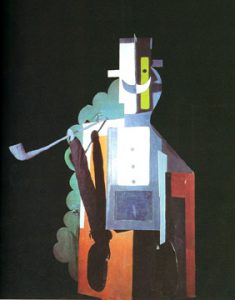
Originally published in 1991, Perloff’s book aims to explore the musical trends that took place after the premier of Erik Satie’s “Parade” in 1917. While she focuses much of her book on composers such as Francis Poulenc, Darius Milhaud, and Jean Cocteau, she makes an interesting argument about collaboration with artists such as Braque and Picasso and why these collaborations are important to discovering the motivation behind creating new trends in creative expression. She writes of how Braque and Picasso both interrupted convention, and that their “conscious attempt… to break from hallowed traditions of the past and to fuse art with commonplace materials formed the crux of their influence on Concteau’s The Cock and the Harlequin”.2 This connection to our past readings in class allowed me to delve into a world where the fine arts are truly connected, and I became more confident in my idea, which is to have Braque write to Picasso a constructive critique of Picasso’s costume design in Erik Satie’s “Parade”, an example of which I included below:
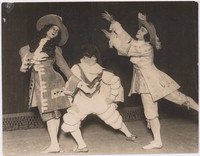
Through more research, I discovered that Braque worked on a ballet called “Les Fâcheux”, which premiered in 1924, just 7 years after the premiere of “Parade”. The music for the ballet was composed by George Auric, and Braque worked on the costume and set design.5 Some other interesting sources come from photos of the ballet, and comparisons can be drawn in my writing to Braque’s costume design and Picasso’s. Through these pictures I can see how Braque may have reacted and what he may have decided to change during his work with a ballet.
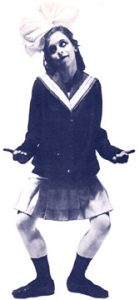
Overall, I want my letter from Braque to Picasso to focus on how convention was being upheaved during the early 20th century. Both artists work with composers such as Cocteau, Satie, and Auric, and there are definitely interesting connections that Braque could make between his own work, Picasso’s artistic decisions, and the compositions and ballets being published at the time. One final source I will mention for now is Scott Messing’s Neoclassicism in Music which mentions several of the artistic techniques used by both Braque and Picasso that reflect the musical techniques being used by composers.7 This source will prove immensely helpful when attempting to mimic Braque’s tone of voice through specific artistic jargon.
1 Perloff, Nancy Lynn. Art and the Everyday: Popular Entertainment and the Circle of E. Satie. Oxford: Clarendon Press, 1994.
2 Ibid., 9
5 Music score to Les Fâcheux Georges Auric. Notated Music. https://www.loc.gov/item/ihas.200156346/.
7 Messing, Scott. Neoclassicism in Music: from the Genesis of the Concept through the Schoenberg/Stravinsky Polemic. Ann Arbor, MI: UMI Research Press, 1988.