When picking my topic for the first paper I was immediately attracted to Josephine Baker. I was familiar with her work as a civil rights activist for both France during World War II and America in the 1950s. While I was aware of her French performing career, I was entirely ignorant of her popularity and celebrity in the 1920’s Paris Jazz Age.
Through my research, I learned that Josephine Baker was connected with nearly every big name in Paris in the 1920s; from Ernest Hemingway to E.E. Cummings to Jean Cocteau. However, as I dug deeper, I discovered a unique relationship between her and an artist by the name of Paul Colin. Until I discovered Paul Colin, I was going to write my essay as a letter from Jean Cocteau to Josephine Baker, as he was an enormous supporter and designed her infamous banana costume which she wore in her revolutionary performance of La folie du jour in 1926.
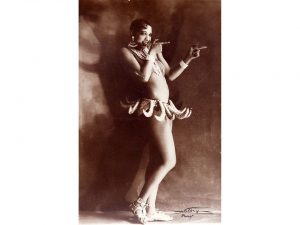
However, while Jean Cocteau was a vocal supporter of Josephine Baker and exemplified the Parisian sentiment now termed “negrophilia,” I believe a more personal and historic relationship existed between Josephine Baker and Paul Colin.
Paul Colin was a French artist who quickly gained popularity after World War I when he was commissioned to create a mural. With the money from that, he purchased a studio and painted 25 paintings which were all sold by 1922. In the following year he was then hired as a poster artist by his army comrade André Daven at the historic but struggling Théâtre des Champs-Elysées.
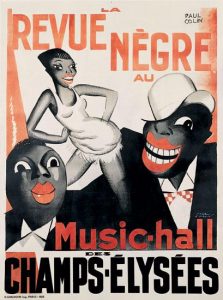
It was at the Théâtre des Champs-Elysées where he met Josephine Baker and La Revue Nègre. Tasked with creating a poster for the theatre, he attended a performance and was inspired, much like the French public would soon be, by the wild, visceral, and sexual nature of “la Joséphine.”
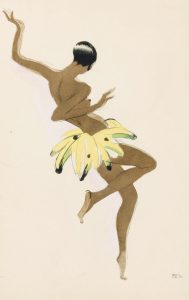
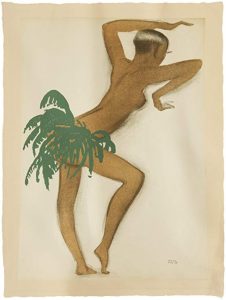
In his process of creating the Revue advertisement, which would catapult both La Revue Nègre and Paul Colin to fame, he met and sketched Josephine Baker nude a number of times. According to the autobiographies of both Paul Colin and Josephine Baker, these sessions were not static but full of movement and dance. Additionally, according to Josephine Baker’s final autobiography, she felt comfortable and confident with Paul Colin in a way she had rarely felt before.
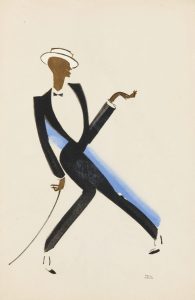
Paul Colin’s sketches, some of Josephine Baker and others inspired by her, were eventually released in a collection of 45 lithographs titled Le Tumulte Noir in 1927. I’ve included some of them below:
The source I found most useful in discovering the symbiotic relationship between Paul Colin and Josephine Baker was the journal article “Josephine Baker and Paul Colin: African American Dance Seen through Parisian Eyes” by Karen C.C. Dalton and Henry Louis Gates, Jr. The article was published in the 1998 edition of Critical Inquiry, a peer-reviewed academic journal in the humanities published by the University of Chicago Press. Professors Dalton and Gates Jr. are both professors at Harvard University, and Professor Gates Jr. is the director of the Hutchins Center for African American research at Harvard. He is also an eminent author, literary critic, and historical filmmaker.
This article not only introduced me to the autobiography Paul Colin, but also provided excellent and in depth historical and cultural context to the relationship between these two historic figures.
Bibliography
Karen C. C. Dalton, and Henry Louis Gates. “Josephine Baker and Paul Colin: African American Dance Seen through Parisian Eyes.” Critical Inquiry 24, no. 4 (1998): 903-34.
Colin, Paul. La Croûte (Souvenirs). Paris, (1957).
Colin, Paul. Le Tumulte Noir. Paris, (1927).