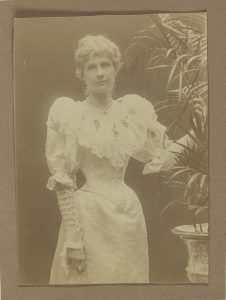
1915 was not a great year for 51-year-old Elizabeth Sprague Coolidge. Her privileged upbringing did nothing to prepare her for the loss of her mother, father, and husband all within months of each other. Though losing her family was incredibly tragic, she ended up inheriting over $4,000,000. Elizabeth Coolidge grew up as an accomplished pianist, composer, and chamber musician, but gave her musical abilities up to focus on being a good wife and mother. With her new-found wealth, Coolidge was able to focus her altruism on her musical passions. One of the first projects she established was the Berkshire Music Festival in 1918 (this festival was the precursor to a little event called THE Tanglewood Music Festival). The first festival first occurred within two months before the armistice of World War I and brought together musicians of nations still locked in deadly combat- the allies (Britain, France, Russia, Italy and the United States) and Germany. Coolidge described it as a sort of “Musical League of Nations.”
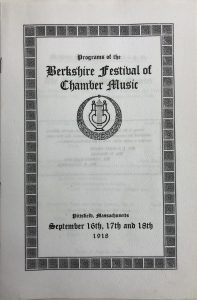
Through the Berkshire Music Festival, Coolidge was able to support musicians from around the world, including France. “Among the attendees were musicians from countries that were still in deadly combat, including violist Ugo Ara from Italy and violinist Fritz Kreisler from Austria, each of whom had fought against the other’s homeland. German cellist Emmeran Stoeber and French oboist, conductor, and composer Georges Longy, listened in appreciation to each other’s music. Hungarian violinist Sandor Harmati played Russian music with the Letz Quartet, and Austrian violinist Hugo Kortschak led his Berkshire String Quartet through a new, prize-winning composition by Polish composer Tadeusz Iarecki, then serving in the Polish Legion in France.”[1]
George Mason, a reporter for The New Music Review (November 1918), wrote that the music and the brightly lit auditorium seemed to symbolize “the preservation of art and the other precious things of civilization from the storms which now threaten them all over the world. Those in attendance, especially those dressed in mourning, were aware of this deeper significance of the festival, of the seriousness, far removed from any mood of mere entertainment, given it by the power of art to minister to sorrow, to inspire hope, [and] to strengthen all high spiritual devotions….”
Elizabeth Coolidge gave French musicians and conductors a refuge in which to perform their music during the horrors of World War I. By being American, she had the opportunity to bring European musicians to the United States and away from the frontlines. She offered a sort of musical oasis; a place in which the French could see the Germans through the lense of music, rather than through politics and war.
Sources
[1] Miller, Cait. A Musical League of Nations: The 1918 Berkshire Festival of Elizabeth Sprague Coolidge. The Music Division of the Library of Congress. 19 September 2018.
[2] Barr, Cyrilla. Elizabeth Sprague Coolidge : American Patron of Music. New York: Schirmer Books, 1998.
Pictures courtesy of the Library of Congress