By the time of the Industrial Revolution, the bourgeoisie had become the economic ruling class in France. They owned the means of production (land and capital) and the means of coercion (armed forces and legal system, police forces and prison system). By owning the means of production, the bourgeoisie was able “to employ and exploit the wage-earning working class (urban and rural), people whose only economic means is labor; and control of the means of coercion suppressed the sociopolitical challenges by the lower classes, and so preserved the economic status quo; workers remained workers, and employers remained employers [1].” In short, life was good for the bourgeoisie who no longer had to worry about royal blood and could instead focus on becoming lawyers, doctors, and business owners. Then World War I hit hard.


France lost 1,322,000 men in World War I, and the country emerged from the war with a large government financial obligation to those disabled by the war, to the 600,000 who had been made widows by the war and to more than 750,000 orphans. France had a labor shortage in its cities and its farmlands. Millions of acres of farmland had gone out of production [2]. In all of this war and tragedy, who has the time or money to pay attention to something as trivial as music? Jean Cocteau credits the bourgeoisie.
Cocteau’s Cock and Harlequin was published a few months after the end of World War I.
In Cock and Harlequin, Cocteau says:
“We must get rid of a Baudelarian prejudice; Baudelaire is bourgeois. The “Bourgeoisie” is the bed-rock of France from which all of our artists emerge. They may possibly get clear of it, but it allows them to build dangerously on substantial foundations [3].”
I don’t think Cocteau particularly likes the power of the bourgeoisie, but he does value constant progress and moving forward- especially when it comes to French music. In this quote, Cocteau’s explaining that the music community must rid themselves of prejudice against the rich. The bourgeoisie are the people making it possible for French artists to be French artists. Having financial support is crucial in becoming an artist, and in war-torn France the only funds were coming from the people living in excess. While artists might have wanted to “get clear of it”, financial support allowed artists and composers to “build dangerously” and embrace the progressiveness Cocteau clearly valued.
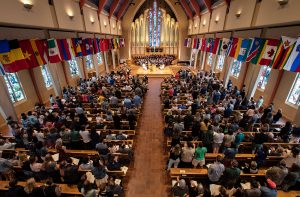
Today, donors play a huge role in the creation and continuation of art. In 2017, The Metropolitan Museum of Art in New York received an $80 million donation from trustee Florence Irving and her late husband Herbert Irving. Conrad Prebys recently gave $1 million for San Diego Opera from Conrad Prebys [4]. Even St. Olaf College relies heavily on donors to support the college and its arts programs. Just last year, an older couple gave a gift of $4.2 million to the St. Olaf music department that will allow students to continue to make music around the world for years to come (you can read the Manitou Messenger article here). Cocteau’s quote is a good reminder that even though the artists themselves may not have the same ideals as their financial supporters, it’s important to be grateful, or at least recognize, that their financial support continues to progress the arts and allows even us here at St. Olaf to live dangerously in the world of the arts.

Sources
[1] Marx, Karl. The Class Struggles in France 1848-1850. Selected Works, Volume 1, Progress Publishers, Moscow 1969. Transcribed by Louis Proyect.
[2] Demiaux, Victor. “Post-war Societies (France)”. International Encyclopedia of the First World War. January 2015.
[3] Cocteau, Jean. Cock and Harlequin: Notes Concerning Music. London: The Egoist Press, 1921.
[4] Boehm, Mike. “America’s 50 top philanthropists include 12 arts donors”. LA Times. February 6th, 2012.
[5] https://www.manitoumessenger.com/2019/money-donated-to-music-department-should-benefit-all/