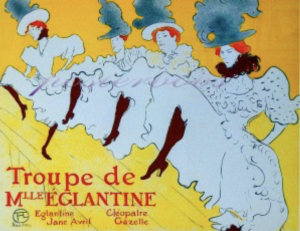
The societal changes that drove music during the “Belle Epoque” were really the same changes that drove the reformation of everything else from technology to art. After establishing the Third Republic in France, an optimistic and proud mindset emerged, finally feeling some stability in France. Musicians and composers used that to their advantage, wanting to create that specific “french sound” that appealed to them and French citizens because they were finally feeling at peace with their country. People started paying more attention because it was played in leisure settings like “salons de musique” and cabarets. (1) This created a pop culture around music that actually caused more arguments between musicians about what music actually constitutes “French.”
In general, the aspects of French debates relating to musical identity were clear, revolving around the idea of individual national identity, that was primarily anti-german. However, there were quite a few contradictions within that idea. The hope to create an entirely original musical sound and style was unrealistic, but that notion was not realized by all composers of the time. Most of the debates didn’t stem from the question of the music sounding French, but more so the question of how “pure” the “frenchness” of the music could be.
Jean Cocteau served to perpetuate these debates, despite him not being a musician or composer himself. Le Coq et L’arlequin became a very influential piece concerning French music during the “belle epoque” which definitely contributed to the idea that music had to be “pure French.” (2) Composers like Ravel and Milhaud brushed it off, knowing that this notion of “pure music” was virtually impossible since all music had to be inspired from somewhere, and usually previous styles of music in this case. Cocteau’s philosophical thoughts on French music had many composers butting heads over who’s music was truly French.
The element that often makes sense to me the last is the use of exoticism in French music during the belle epoque. Debussy, Ravel, and many other composers had clear elements of other cultures’ music, especially those seen as “lesser countries” to the French, like gamelan music or “gypsy” music. Additionally, both composers drew upon their southern neighbors, incorporating Spanish influence into their music (3). I wonder why they saw those types of music as a fit into French music, whereas German classical music, already similar to French music was completely off limits as an influence to French composers. French composers such as Saint-Saens had done similar things with “exotic” influences in music, so was that another form of “frenchness” in music? Were the composers of the early twentieth century trying to incorporate the earlier French composers or actually draw upon other cultures in a new way? I wonder if the incorporation of “exotic” music into French compositions was really an appropriation of those types of music, or a jab at Germany, saying that these countries were better to create music from than they were? Or both?
Audio Recording of Ravel’s Scheherazade (4) Audio Recording of Debussy’s Images pour Orchestre: Ibéria (6)
Program Notes on Ravel’s Scheherazade (5) Program Notes on Debussy’s Images pour Orchestra: Ibéria (7)
(1): Le Troupe de Mlle Églantine: Commissioned by Cabaret Dancer Jane Avril to Advertise Her Appearance at the Palace Theatre in London (1896). April 5, 2016. Long Wharf Theatre . https://www.longwharf.org/wp-content/uploads/2016/04/4.-toulouse-lautrec-troupe-de_mlle-eglantineebay.jpg.
(2): Cocteau, Jean. Cock and Harlequin. Notes Concerning Music .. London: Egoist Press, 1921.
(3): Berkeley Daily Planet. “Arts & Events.” Ravel & Debussy: Orientalism & Exoticism. Category: Arts & Events from The Berkeley Daily Planet. Accessed February 25, 2020. http://www.berkeleydailyplanet.com/issue/2018-04-20/article/46657?headline=Ravel-Debussy-Orientalism-Exoticism–Reviewed-By-James-Roy-MacBean.
(4): neuIlaryRheinKlange. “Maurice Ravel – Shéhérazade, ouverture de féerie” YouTube video, 13:30. September 1, 2012. https://www.youtube.com/watch?v=4cAL2qW-IQ4
(5): “Program Notes-Ravel: Shéhérazade, Three Poems of Tristan Klingsor for Voice and Orchestra.” San Francisco Symphony. Accessed February 25, 2020. https://www.sfsymphony.org/Data/Event-Data/Program-Notes/R/Ravel-Sheherazade.
(6): Paco M. “Claude Debussy: Ibéria, Images pour orchestre II (1912)” YouTube video, 18:49. December 23, 2015. https://www.youtube.com/watch?v=8v0LGIuhOsU
(7): “Program Notes- Debussy: Iberia from Images Pour Orchestra.” San Francisco Symphony. Accessed February 25, 2020. https://www.sfsymphony.org/Data/Event-Data/Program-Notes/D/Debussy-Iberia-from-images-pour-orchestra.