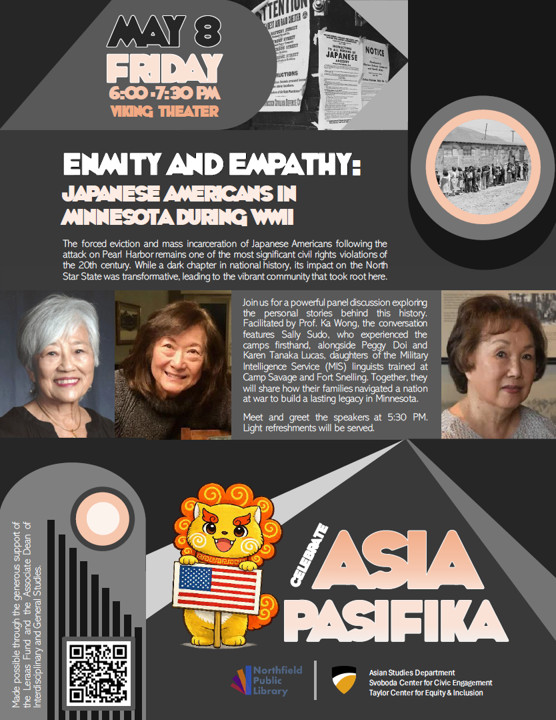
Enmity and Empathy: Japanese Americans in Minnesota During WWII
The forced eviction and mass incarceration of Japanese Americans following the attack on Pearl Harbor remains one of the most significant civil rights violations of the 20th century. While a dark chapter in national history, its impact on Minnesota was transformative, leading to the vibrant community that took root here. Join us for a powerful panel discussion exploring the personal stories behind this history. Facilitated by Prof. Ka Wong (Asian Studies), the conversation features Sally Sudo, who experienced the camps firsthand, alongside Peggy Doi and Karen Tanaka Lucas, daughters of the Military Intelligence Service (MIS) linguists trained at Camp Savage and Fort Snelling. Together, they will share how their families navigated a nation at war to build a lasting legacy in the North Star State.
- Peggy Doi is the oldest of Bill and Peggie Doi’s five children. Her parents were very much a part of the Japanese community. Her dad was very active in the Twin Cities Japanese American Citizen’s League (JACL) and the community at large both locally and nationally. She was born and grew up in Minneapolis and received a BS degree in Medical Technology from the University of Minnesota. She worked primarily in pharmaceutical research and public health, working with several national public health agencies. She retired and moved back to the Twin Cities in 2009 to care for her parents. Currently, she is a member of Corpus Christi Social Justice committee and is very active with the Minnesota Nikkei Project, a non-profit service group to aging Japanese in the Twin Cities area; a group spearheaded by her father in 1978. She is a member of the Twin Cities JACL Education Committee and the RASP (Roseville Area Senior Program) Advisory Council, and one of the volunteer directors for a non-profit gift shop at the Aŋpétu Téča (awn-BET-doo TEH-cha) Education Center.
- Karen Tanaka Lucas is a third generation Japanese American and a long-term Apple Valley resident. She is the daughter of a former U.S. Military Intelligence Service officer who trained in Savage, Minnesota during WWII. She considers herself a native Californian and received her bachelor’s degree from Stanford University. But since attending graduate school, medical school and residency at the University of Minnesota she’s been a Minnesotan for over 50 years. She retired after 31 years as a family physician with HealthPartners. Currently serving as a board member with the Twin Cities Chapter of the Japanese American Citizens League, she volunteers on their education committee. Her family recently self- published her father’s autobiography, When a Tiger Dies: The Life of Walter Tanaka (2022).
- Sally Sudo is a Nisei (second-generation Japanese American) originally from Seattle. At the age of six, she and her family were forcibly incarcerated at the Minidoka camp in Idaho during World War II. After the camp’s closure, one of her older brothers, who had served in the Military Intelligence Service at Fort Snelling, helped relocate the entire family to Minnesota. Sally later attended the University of Minnesota, where she met her husband. Together, they raised three children and spent 17 years living in Japan. Since returning to Minnesota in 1984, Sally has been a dedicated teacher in the Minneapolis public schools and community leader within the Twin Cities Japanese American Citizens League (TC-JACL), serving as Chair of its education committee alongside other significant contributions. A recipient of the 2022 Tom Oye Award from the City of Edina’s Human Rights and Relations Committee, she continues to share her family’s story, advocating for justice and standing against discrimination, even in her retirement.
- Made possible through the generous support of the Leraas Fund and the Associate Dean of Interdisciplinary and General Studies.
Date: May 8, 2026 (Friday)
Time: 6:00 – 7:30 PM
Location: Viking Theater